

The warranty on OEM versus aftermarket car accessories in the UAE depends less on the label and more on whether the part, its quality and its installation caused the claimed failure. Under Article 10, suppliers must honor warranty terms regardless of where the car is serviced, provided the workshop holds ESMA certification and uses suitable parts and procedures. A claim may be refused when a specific incorrect or defective part directly caused the failure.
Aftermarket parts are made by companies other than the vehicle’s original manufacturer. That does not automatically mean they fit poorly or void the vehicle warranty. What matters for the accessory is its own warranty: what it covers, how long coverage lasts, and which conditions or exclusions apply.
It is easy to focus on an accessory’s category and overlook the paperwork that explains what happens if something goes wrong. This guide compares OEM and aftermarket accessory warranties, explains what consumer product protection may include in the UAE, and shows you how to read a limited warranty before choosing an accessory. It also offers practical checks for fit, installation and record-keeping, especially for Chinese cars driven in summer heat, sun and dust.
Key Takeaways
- OEM and aftermarket labels alone don’t determine warranty risk; part quality, fit and installation are important factors.
- Understand how UAE consumer protection rules relate to vehicle servicing and warranty claims.
- Before choosing an aftermarket accessory, look for its limited warranty terms, including coverage, duration and exclusions.
- Keep service and parts records together so you have useful documentation if a warranty issue arises.
- Compare the actual coverage and conditions for each accessory, then choose the option that suits your car and how you use it.
Consumer product coverage
In the UAE, consumer protection rules and written warranty terms shape coverage for car accessories. Article 10 also addresses vehicle warranties when servicing takes place outside a dealer network. The warranty on OEM vs aftermarket car accessories depends on the relevant document and the circumstances of a claim.
OEM Accessory Coverage
Genuine parts are supplied by the vehicle manufacturer and match parts fitted at the factory. OEM parts are made by the original equipment manufacturer, or for it to its specifications, and supplied in non-branded packaging. An accessory’s warranty still depends on its own terms, which identify covered defects, the coverage period and conditions that can limit a claim.
Aftermarket Accessory Coverage
Aftermarket parts come from companies other than the original vehicle manufacturer. Their warranties are offered by the part maker, and some may be less comprehensive than OEM coverage. The label alone does not establish what you can claim. Read the accessory’s actual terms, including covered parts, duration, claim conditions and exclusions. Its warranty is separate from the vehicle’s warranty.
The UAE’s consumer protection framework includes Federal Law No. 15 of 2020. Consumer protection rules outlined in applicable federal legislation may also be relevant to warranty terms. Under Article 10, warranty terms must be honored regardless of where the car is serviced, provided the workshop holds ESMA certification and uses suitable parts and procedures. These conditions connect servicing arrangements with vehicle warranty coverage.
Keep the accessory warranty separate from the vehicle warranty. The first covers the named part; the second concerns the car and its covered systems. If a claim involves a repair, the cause matters. In the UAE, a dealer can refuse a vehicle warranty claim when it demonstrates that a specific incorrect or defective part directly caused the claimed failure. Simply fitting an accessory does not establish that cause.
- Identify the warranty: Determine whether the document covers the accessory, the vehicle, or both.
- Read the scope: Note the covered part, duration, conditions and exclusions stated in the terms.
- Keep evidence: Retain warranty documents and records of parts used and service performed.
For UAE owners, compare the written coverage and the conditions attached to a repair claim. The category alone does not settle the question. If an accessory is involved in a failure, service records can help show what work was done and which part was fitted. Review the accessory and vehicle warranties separately, then consider how the part and installation relate to the repair being claimed.
Checking an aftermarket part's warranty for Jetour Traveller T1 and T2
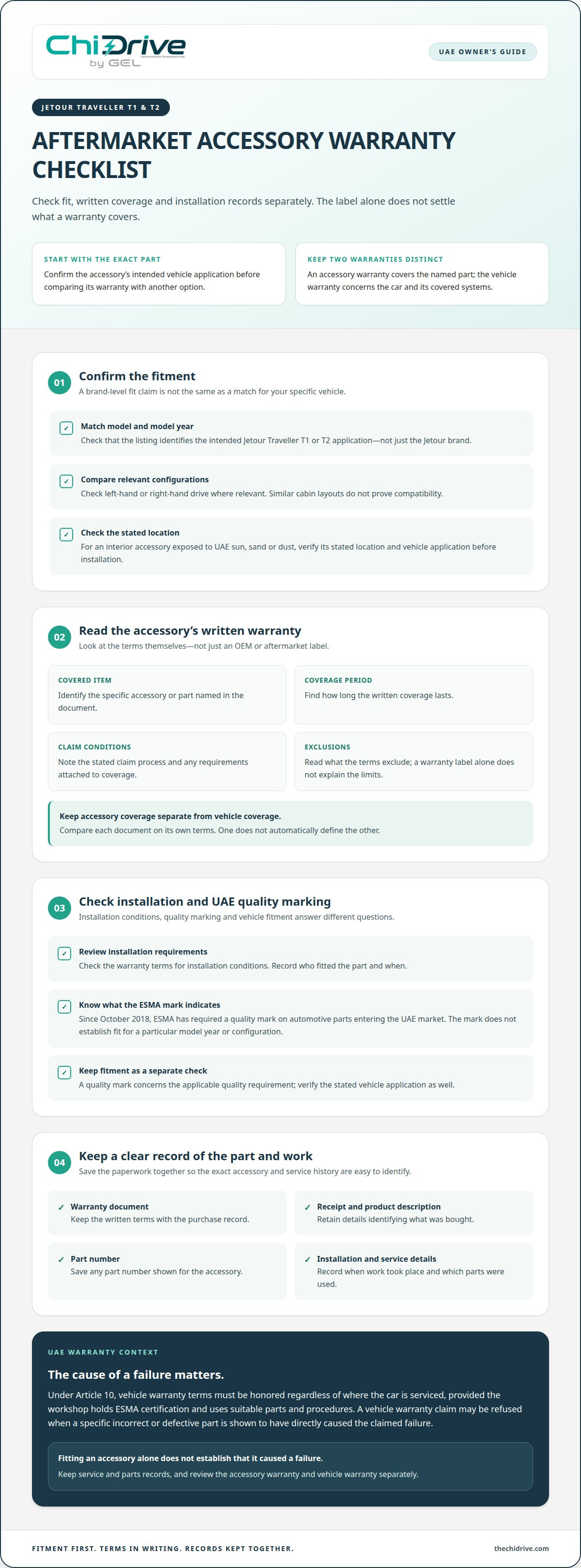
To check whether an aftermarket accessory suits your car, match its stated application to your vehicle’s make, model, year and configuration. A broad claim such as “fits this brand” does not establish compatibility with your specific vehicle. Compare the warranty on OEM vs aftermarket car accessories only after identifying the exact part and intended vehicle.
Read the accessory’s warranty separately from the vehicle warranty. Identify the covered item, coverage period, claim process and exclusions. A warranty label alone does not explain what happens if the accessory develops a fault or contributes to a repair issue. In the UAE, match the product’s stated application to your vehicle rather than relying on a general brand description.
Use this practical sequence before choosing a part:
- Match vehicle details. Compare the listing with your exact model and model year. For example, a BYD accessory listing should identify its intended BYD model, not just the brand.
- Compare configurations. Check details that affect fit, such as left-hand or right-hand drive, where relevant. Similar cabin layouts don’t prove compatibility.
- Read the warranty. Find the covered accessory, duration, claim process and exclusions. Keep the document with your purchase record.
- Review installation conditions. Note any requirements stated in the terms. Record who installed the part and when, alongside relevant service details.
- Retain identification. Save the receipt, product description and any part number shown. These help identify the exact accessory if a claim arises.
Fitment and market quality marking are separate checks in the UAE. Since October 2018, ESMA has required a quality mark on automotive parts entering the UAE market. That mark concerns the applicable quality requirement; it doesn’t establish that a part fits a particular model year or configuration. Check the stated vehicle application as well.
After installation, keep records of the work, when it took place and which parts were used. If a later repair involves the accessory, these records help clarify the sequence and identify the component. Store the warranty terms with the installation record instead of relying on a product listing that may change.
Accurate fitment is especially practical in UAE driving conditions. For an interior accessory exposed to sun, sand or dust, confirm its stated location and vehicle application before installation. Correct fit can help avoid fitment problems, but it does not expand written coverage. Assess the warranty on OEM vs aftermarket car accessories through the part’s documented terms, not its label alone.
Use the same checks for a small cabin accessory as for a larger part: identify the vehicle, read the terms and keep the records. A careful comparison starts with the accessory’s documented application and the conditions attached to its coverage.
Limited warranty terms for BYD Song Plus accessories
A limited warranty sets boundaries around a specific accessory. For a BYD Song Plus accessory, read the warranty as applying to that named item, not as a promise covering every cabin component. The wording may limit the coverage period, the parts included or the conditions that apply. Start your comparison with what the document actually promises.
Separate the accessory from anything it interacts with. If a cabin organiser is covered, that wording does not automatically include a console surface or another vehicle part. Likewise, a remedy for an accessory fault does not necessarily cover a separate vehicle repair. Look for terms that identify the item, the fault covered and what the warranty provider will do if the claim meets its conditions.
Read each condition in practical terms. If coverage depends on installation or use, understand what the document requires before fitting the accessory. For a BYD Song Plus owner, that could mean distinguishing an accessory issue from a mark or fault elsewhere in the cabin. The warranty wording, not the accessory’s position in the vehicle, defines its scope.
Use this checklist to interpret the document:
- Named item: Does the warranty identify the exact accessory?
- Covered fault: Which defect or failure does its wording address?
- Coverage limits: What duration, component limits or conditions apply?
- Exclusions: Which circumstances does the document leave outside coverage?
- Claim outcome: What response does the warranty promise for an eligible claim?
Keep the accessory warranty separate from the vehicle warranty. In the UAE, a dealer can refuse a vehicle warranty claim when it demonstrates that a specific incorrect or defective part directly caused the claimed failure. That concerns the vehicle claim; the accessory’s own document governs its stated coverage. Records identifying the part and work performed can help clarify which issue is being assessed.
Do not rely on broad phrases such as “warranty included” when detailed terms are available. For a BYD Song Plus accessory, compare the exact wording with the accessory’s intended role and the coverage you value. Narrower coverage may suit a simple cabin item, while a more involved accessory calls for closer attention to conditions and exclusions. Clarity matters more than the label.
What warranty do OEM car accessories come with in the UAE?
Genuine car parts often come with a warranty, but the category name does not establish an accessory’s exact coverage. For an OEM accessory, use its written warranty to identify the period, covered component, conditions and claim process. These details define the protection, not the label alone.
Start with the document supplied for the specific accessory. Check that it identifies the part you bought rather than referring broadly to vehicle accessories. For example, a written warranty for a cabin accessory may cover only that item. It does not automatically extend to the dashboard, vehicle electronics or related repair work.
Next, find the start and end of the coverage period. The terms may tie the start to a stated event, such as purchase or installation. Follow the document’s wording and keep the receipt or installation record that supports the relevant date. Do not assume the vehicle and accessory warranties cover the same period.
Coverage also depends on what the warranty promises if a covered fault occurs. Check whether it provides for repair, replacement or another remedy, and note any claim steps. A promise to address a covered defect does not necessarily include associated vehicle repairs. These are separate questions, and the written scope matters.
Use this document check for an OEM accessory:
- Part identity: Match the accessory name or identifier to the item fitted.
- Coverage period: Record the stated duration and when it begins.
- Covered fault: Find the defect or failure described in the terms.
- Conditions: Note requirements for installation, use or maintenance.
- Claim process: Keep the instructions and supporting documents together.
Consider a Jetour cabin accessory as an example. Its warranty document should make clear whether coverage applies to that particular accessory or a wider set of components. If the terms specify installation conditions, keep the related service record. This links the part, the work performed and the warranty wording in the claim file.
UAE owners should also keep accessory terms separate from the vehicle’s warranty booklet. The booklet addresses the vehicle’s stated coverage; the accessory document addresses its named part and conditions. If a repair involves both, retain records for each. Clear documentation helps identify which warranty applies to the reported fault.
Compare an OEM accessory’s written terms with any alternative before deciding. Focus on scope, duration, exclusions and the promised response to a covered claim. A familiar label can’t replace those details. The stronger practical choice is the one whose documented coverage fits the accessory and your intended use.
What is covered and excluded under OEM versus aftermarket accessory warranties?
OEM and aftermarket warranties can both cover a defect in a named accessory, but their terms define the limits. Genuine parts often come with a warranty, and some aftermarket manufacturers provide one too. The label alone does not show which document offers broader coverage. Compare the parts covered, duration, conditions and claim response.
For an OEM accessory, look for wording that identifies the item and the fault covered. The warranty may limit coverage to that accessory and the conditions listed in its terms. An aftermarket warranty may also cover a specified part, but some are less comprehensive than OEM warranties. You can see the difference only by comparing the documents.
Exclusions matter as much as coverage. A limited warranty may restrict its duration, the parts covered or the conditions that apply. If an accessory warranty names one component, for example, do not assume it covers a separate vehicle component or related repair. Read the terms to understand the precise scope and remedy.
Use these criteria to compare two accessory warranties side by side:
- Covered item: Does the document identify the exact accessory and any included components?
- Covered issue: What fault or defect does the warranty address?
- Limits: Which duration, conditions or exclusions narrow its coverage?
- Claim response: What does the warranty say the company will do?
- Vehicle impact: Does the issue concern the accessory alone or a separate vehicle repair?
Keep accessory coverage separate from the car’s warranty. A manufacturer may be able to void a warranty if it determines that an aftermarket alteration caused the damage. The part’s category alone does not establish that connection.
For example, imagine an aftermarket cabin accessory is fitted and a separate vehicle fault appears later. Ask whether the accessory warranty covers a defect in that item and whether evidence connects it to the vehicle fault. A claim about the accessory and a vehicle repair claim involve different coverage documents. Keep receipts and service records to distinguish the part, installation and repair.
In the UAE, compare the actual terms before choosing between OEM and aftermarket options. A familiar OEM label is no substitute for close reading, and an aftermarket warranty should not be dismissed without reviewing its terms. Choose coverage that suits the accessory and its intended use.
Explore accessories by vehicle brand
TheChiDrive: Jetour Accessories
TheChiDrive offers Jetour Accessories for UAE owners looking to enhance their vehicle’s comfort, protection or style. Before choosing an accessory, match its stated vehicle application to your Jetour model and configuration, then review its own warranty terms separately from the vehicle warranty.
That distinction matters in daily UAE driving, where cabin accessories face strong sun, dust and frequent use. A clear fit and a readable warranty help you choose with practical priorities in mind, without assuming an accessory changes the car’s existing coverage. Explore Jetour accessories to find options for your vehicle.
Contact TheChiDrive to explore Jetour Accessories for your car.
Choose accessories with confidence for every drive
Your decision about the warranty on OEM versus aftermarket car accessories is part of a broader ownership choice. Consider how an accessory fits your driving routine, the comfort or protection it adds, and whether its documented coverage suits its intended role. In the UAE, details matter: a considered cabin upgrade should work for bright commutes, dusty roads and long days out.
TheChiDrive offers Jetour Accessories, BYD Accessories and Avatr Accessories for owners shaping their cars around everyday life. Explore options with your vehicle and priorities in mind, then use the product and warranty information to guide your selection. A thoughtful choice can make each journey feel more personal while keeping practical fit in view.
Your next upgrade can be a small detail that makes a meaningful difference to your drive. Choose with care and make your car feel distinctly yours.
Frequently Asked Questions
Can Dealers Refuse a Warranty Claim?
Yes. A UAE dealer can refuse a vehicle warranty claim when it demonstrates that a specific incorrect or defective part directly caused the claimed failure. The mere presence of an aftermarket accessory does not prove that connection. For example, an unrelated vehicle fault is not automatically explained by an interior accessory. Keep repair findings and service records together to distinguish the part from the reported failure.
Is the Price Difference Worth It?
It can be, if an aftermarket option suits the vehicle and its coverage meets your needs. Aftermarket parts are generally less expensive than genuine parts and can offer more choice, particularly for older or rare vehicles. For a newer car or a component related to safety, weigh the trade-offs carefully. Consider fit, quality, installation and written coverage rather than treating a lower purchase price as the only measure of value.
What warranty do aftermarket car accessories come with in the UAE?
Coverage for an aftermarket accessory depends on the warranty offered for that specific part. Some aftermarket manufacturers provide warranties, and their terms may be less comprehensive than OEM coverage. For example, a cabin accessory’s warranty might cover the named item but not a separate vehicle repair. Check the actual terms for scope, duration, conditions and exclusions. The aftermarket label does not establish what a claim covers.
How long do OEM and aftermarket accessory warranties typically last?
There is no single duration for every OEM or aftermarket accessory. Each written warranty sets its own coverage period and may limit the parts or conditions covered. For a direct comparison, use the start and end points stated in each document. Vehicle and accessory warranties can have different periods, so do not assume an accessory inherits the car’s remaining coverage.
Do UAE dealers void the car warranty if aftermarket accessories are installed?
No. Installing an aftermarket accessory does not automatically void the entire vehicle warranty. In the UAE, a dealer can refuse a claim when it demonstrates that a specific incorrect or defective part directly caused the failure being claimed. The key distinction is between fitting an accessory and establishing that it caused damage. A claim involving a separate fault must be considered in light of that fault and evidence about its cause.
Are OEM accessory warranties covered by the vehicle manufacturer or the dealer?
The warranty document identifies who is responsible for accessory coverage, so check its issuer rather than assuming the vehicle manufacturer or dealer handles every claim. Genuine parts often come with a warranty, but the responsible party and claim process depend on the terms. TheChiDrive is an independent retailer. We are not affiliated with, endorsed by, sponsored by or authorised by any vehicle manufacturer or brand. All manufacturer, brand and model names are the property of their respective owners and are used solely to describe the vehicles our accessories are designed to fit.
How do warranty claims for aftermarket accessories work in the UAE?
First, identify whether the issue concerns the accessory itself or a vehicle system. Keep the accessory warranty, purchase record and installation or service details together, then follow the claim steps in that warranty. If a vehicle repair claim involves the part, the connection between the part and the failure matters. Records can help establish which accessory was fitted and what service took place.


