

A familiar logo can still appear on a counterfeit. For UAE owners choosing Jetour accessories, look beyond branding: check the part number, finish, packaging, fit and purchase records. Knowing how to spot fake vs genuine car accessories starts with those details, not appearance alone.
Caution is sensible: a polished listing or tempting offer cannot establish authenticity on its own. A closer comparison may reveal warning signs, such as rough edges, faded logos, missing security marks or product details that do not match.
This guide shows you how to compare an accessory with your Jetour’s requirements, assess a seller and an unusually low offer, and review invoices, payment records and warranty documents. It also considers UAE driving conditions, including strong sun, heat, dust and daily mall parking. Use these checks before you buy, so the accessory you choose suits your vehicle and routine.
Key Takeaways
- Choose sellers with clear credentials and a traceable connection to the vehicle brand; vague listings and unusually low prices deserve closer scrutiny.
- Compare part numbers and security features with official brand information, rather than relying on logos or product photos alone.
- Inspect the accessory’s finish, packaging, markings and fit for inconsistencies that could signal a counterfeit.
- Consider how an unsuitable component could affect vehicle performance, safety or other parts, especially in demanding UAE conditions.
- Keep an itemised invoice, warranty documents and payment records so the purchase is easier to trace if an issue arises.
1. Buying from authorized dealers and certified retailers for Jetour accessories
For a Jetour accessory, begin with the vehicle brand’s official UAE channels. An authorized dealer has a formal connection with the manufacturer, offering a clearer route to product support than an anonymous online listing. That connection matters when you need help with fitment, compatibility or a later product issue. It also makes it easier to distinguish verified authorization from a claim in an advertisement.
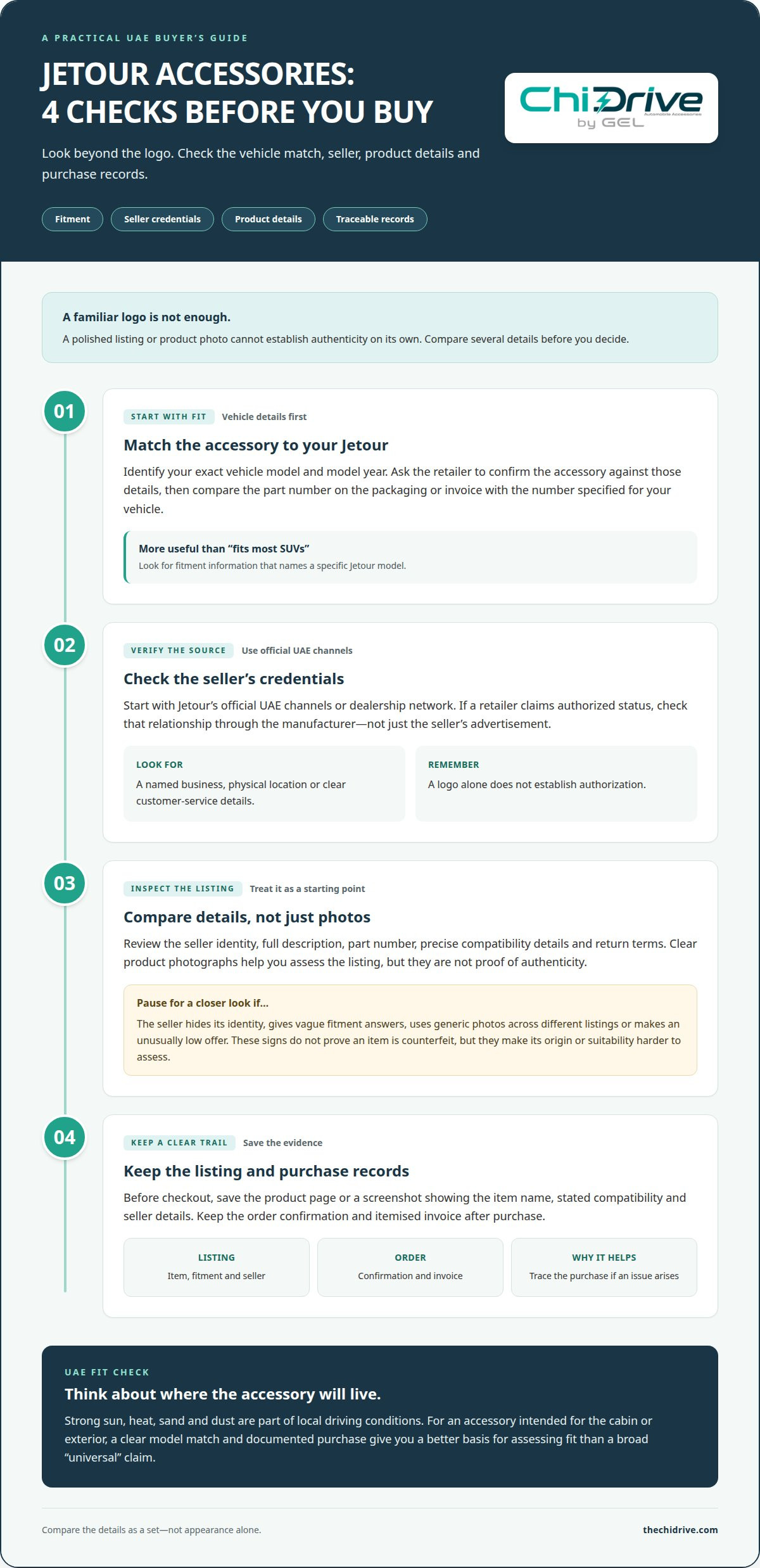
Before buying in person, identify your vehicle’s exact model and model year. Ask the dealer to match the accessory to those details, then compare the part number on its packaging or invoice with the number specified for your vehicle. “Fits most SUVs” provides less useful fitment information than a listing naming a specific Jetour model.
Check the retailer’s credentials through the vehicle manufacturer’s official UAE website or dealership network. Look for a named business, a physical location or clear customer-service details, and consistent branding across its website and purchase documents. A logo alone doesn’t establish authorization. If an online seller claims official status, use the manufacturer’s own channel to see whether that relationship can be verified.
Online shopping makes it convenient to compare accessories from home, but treat the product page as a starting point, not proof of authenticity. Review the full description, seller identity, fitment details and return terms before paying. Save the listing or take a screenshot showing the item name, stated compatibility and seller details. These records can help if the delivered item differs from what you selected.
Use these checks before checkout:
- Match the vehicle: Compare the accessory’s stated make, model and model year with your vehicle documents.
- Trace the seller: Look for a business name and verify any authorization claim through the manufacturer’s official UAE channel.
- Review the listing: Check for a part number, precise compatibility details and clear product photographs.
- Keep a record: Save the product page and order confirmation with the invoice after purchase.
Be cautious if a seller hides its identity, gives vague fitment answers or uses generic photographs across different listings. These signs do not prove an item is counterfeit, but they make its origin and suitability harder to assess. To spot a fake Jetour accessory, give more weight to traceable seller details and vehicle-specific information than to persuasive wording.
In the UAE, practical fit matters more than the product photo. An accessory for a vehicle exposed to strong sun, heat, sand and dust should suit its intended cabin or exterior location. A clear model match and documented purchase provide a better basis for assessing fit than a broad “universal” claim.
2. Comparing manufacturer and aftermarket parts for BYD accessories
To check whether a BYD accessory suits your car, match its stated model and model year to your vehicle details. Where applicable, compare the part number with the BYD parts catalogue, then review the accessory’s intended use and fitment information. A matching number helps identify the part, but does not prove it is genuine.
Manufacturer parts are made to a vehicle’s specifications. Aftermarket accessories are produced and sold separately, and may have a different design or function. They are not automatically counterfeit. A counterfeit misrepresents its identity or branding, while a legitimate aftermarket accessory is presented as a separate product. Keep that distinction clear when comparing BYD options.
Start with the identification number printed on the part or packaging. Search for it in BYD’s official parts information, or use an authenticity tool if the manufacturer provides one. Compare the result with the accessory’s description, not just its appearance. Check that the number corresponds to the component and vehicle application you intend to buy.
Next, inspect any barcode, security QR code or tamper-evident hologram. Scan the code through the manufacturer’s official website or verification channel, rather than following a link supplied only by the seller. Confirm that the result identifies the same product and brand shown on the item. A code leading to unrelated information or a damaged label warrants closer attention.
Some manufacturers and aftermarket producers provide online tools for checking part numbers and authenticity. Use the tool named on the relevant brand’s official website. If a search returns several variants, compare the full code and product description. Similar-looking parts may differ in dimensions, connection points or intended vehicle applications.
- Match the full number: Compare every letter and digit with the official catalogue entry.
- Check the code: Use an official verification channel and compare its result with the item.
- Review fitment: Confirm the stated BYD model, model year and component type match your vehicle.
- Read the documentation: Check any supplied quality documentation against the product’s name and identifying details.
A catalogue match is useful evidence, but not a complete authenticity test. Compare the number with the packaging, product description and any security features as a set. If details conflict, pause before buying and use the manufacturer’s official verification channel. Precise fitment also matters for everyday comfort and use in the UAE, particularly for an accessory placed in a sun-exposed cabin.
3. What Are Original And Counterfeit Auto Parts?
A genuine part comes from the vehicle maker or an original-equipment parts producer and is designed to meet stated vehicle specifications. A counterfeit imitates a genuine item’s branding or appearance without meeting the same standards. For BYD or Jetour owners, the difference can affect more than the cabin’s finish: it can affect how a component fits and functions.
Penalties in the UAE depend on the applicable rules and the circumstances of a sale. Giving a single penalty figure would be misleading without identifying the conduct and relevant rule.
Counterfeit parts can raise serious performance and safety concerns. Fake brake pads or discs may not provide adequate stopping power, increasing the risk of brake failure. Counterfeit steering or suspension components can affect handling, tyre wear and stability. A part that looks similar to the original may still differ in materials, dimensions or performance.
Some counterfeits can also cause knock-on problems. Oil filters with inadequate filtration material may contribute to engine noise or component wear. A cooling-system part that cracks or leaks at high operating temperatures may contribute to overheating. The possibility makes careful inspection particularly relevant in UAE summer conditions.
Brake parts, spark plugs, filters, batteries, sensors and tyres are among the items that can be counterfeited. Each has a distinct role: an unsuitable sensor can trigger operational errors, while a poor-quality filter may not protect the system as intended. A convincing logo or familiar shape should never be the sole basis for judging a component.
Inspect the item and its packaging closely. Compare the suspected part with a known original, paying attention to weight, texture, coating and finish. Genuine components may have a smooth finish, correctly placed branding, matching part numbers and clear packaging. Warning signs include rough edges, faded logos, spelling errors, missing manufacturer details or damaged security marks.
- Inspect the finish: Compare edges, coating and texture with the equivalent original part.
- Check the markings: Look for consistent branding and matching identification numbers.
- Review the package: Note misspellings, faded graphics or missing security features.
- Consider the fit: Be cautious of a supposedly vehicle-specific part presented as suitable for every model.
These signs are clues, not proof on their own. A mismatched number, rough finish and unclear packaging together warrant more scrutiny than a single cosmetic difference. For a safety-critical component, such as a brake disc or tyre, do not rely on appearance alone. Check its identity and intended application using the steps in the previous section.
4. Checking the seller and price
In the UAE, start with an authorized dealer or a retailer with clear business details and a traceable connection to the vehicle brand. Check the seller’s identity, listed address and product information before choosing an accessory for a BYD, Jetour or another Chinese-brand vehicle.
A credible listing should identify the seller and describe the item precisely. Compare its name, part number and stated vehicle fitment with the manufacturer’s catalogue. An anonymous account offering a “universal” accessory without a clear product identity leaves little to assess. A professional-looking logo or product photo alone does not verify the seller or item.
Price is a warning signal, not proof. Compare the same accessory, part number and package contents across identifiable UAE retailers. If one listing is dramatically cheaper than comparable offers, check the description for a reason, such as a different component or condition. If there is no clear explanation, treat the price gap as a prompt for closer scrutiny, not an automatic verdict.
Review the complete product page before checkout. Check whether the seller names the compatible make and model, explains the item’s intended use and shows images of the product and packaging. For example, a cabin accessory described for a specific Jetour model should not rely only on a generic SUV image. A mismatch between the headline, photos and compatibility details is a warning sign.
Use these checks to assess a UAE online seller:
- Identify the business: Look for a consistent seller name and clear business details across the listing and checkout.
- Inspect the claim: Compare stated brand, part number and fitment with the official vehicle catalogue.
- Compare like with like: Check that competing listings describe the same item and package contents.
- Read the offer carefully: Note vague descriptions, generic photographs or unexplained price differences.
Seller reviews can add context when they describe a specific purchase, such as an accessory arriving with the listed markings or fitting the stated vehicle. Treat brief praise without product details cautiously. A review cannot replace a part-number match or establish official authorization, but repeated comments about incorrect items or misleading descriptions are worth considering.
For UAE drivers, a sound decision balances price with fit and traceability. Sand, dust, intense sun and hot cabin conditions make a precise match more practical than a vague bargain. Before paying, save the listing details and seller identity. This gives you a record of what was represented if the delivered item differs.
5. Receipts, warranty cards, and traceable payments
A receipt links a specific accessory to a seller and purchase date. Before leaving a shop or completing an online order, make sure the invoice identifies the seller, item and part number. For a BYD cabin accessory, a generic entry such as “car item” offers less useful evidence than the exact description and identification code.
Keep the warranty card with the invoice and packaging. Compare the card’s brand, product details and terms with the accessory you received. A blank card, mismatched part number or different brand name creates a gap in the purchase record. Keep digital copies alongside the original documents, especially when an online order confirmation contains the item description.
Payment records provide another traceable link. Use a payment method that produces a transaction record, then save the confirmation with the seller’s name and order details. For an online Jetour accessory, keep the order email, payment confirmation, product listing and delivery record together. A bank or payment statement can help identify the transaction, but it does not prove the item’s authenticity by itself.
Use a simple record-keeping sequence after purchase:
- Save the listing: Keep the page or screenshot showing the item name and stated vehicle fitment.
- File the invoice: Check that it includes the seller’s details and the accessory’s part number.
- Keep the warranty card: Match its product information to the item and invoice.
- Retain payment evidence: Store the transaction confirmation with your order and delivery records.
If you discover that you bought a suspected counterfeit in the UAE, stop using it, especially if it affects braking, steering, tyres or another safety-related system. Keep the part, packaging, invoice, warranty card, listing and payment record. Then raise the discrepancy with the seller and your payment provider. Avoid altering or discarding the item while documenting how it differs from the listing.
For example, if a brake component’s part number differs from the invoice, document both details. Photograph the markings, packaging and visible mismatch. Keep your messages with the seller and note the order reference. If the payment provider reviews the transaction, the invoice and correspondence help establish what you bought and what arrived.
Review the paperwork as carefully as the accessory itself. A seller’s name, matching part number, written warranty details and traceable transaction together create a stronger purchase record. Missing documents do not automatically prove a counterfeit, but they can make questions about the item and sale harder to resolve.
TheChiDrive: Jetour Accessories
TheChiDrive offers Jetour accessories for UAE owners looking to personalise and equip their vehicles. When choosing an interior or exterior accessory, apply the same careful approach: compare the product details with your Jetour’s exact model and year, then review the stated fitment before ordering.
You can also explore accessories for BYD, Avatr and NIO. A vehicle-specific match matters in daily UAE driving, where strong sun, dust and regular parking can shape what you want from your car’s comfort and style. Product details help you assess whether an accessory suits your intended use and vehicle.
Browse the Jetour accessories collection for options, or visit TheChiDrive to explore the range.
Choose with confidence for every UAE drive
Authenticity is more than a detail on a box. It is part of choosing an accessory that suits your vehicle, routine and driving conditions, from strong UAE sun to dusty roads and busy parking areas. Use these checks to make each purchase a considered choice, not a rushed reaction to a polished listing or tempting offer.
Knowing how to spot fake vs genuine car accessories gives you a stronger starting point. Next, choose an accessory for your specific vehicle and review its fitment and product details before ordering. TheChiDrive offers Jetour, BYD and Avatr accessories for owners seeking vehicle-focused options.
Whether you’re refining the cabin or adding a useful finishing touch, focus on the match that makes sense for your car and routine. A thoughtful choice can make everyday driving feel more personal.
Choose carefully, drive comfortably and enjoy making your vehicle your own.
Frequently Asked Questions
What Are Original And Counterfeit Auto Parts?
Original parts are made by a vehicle manufacturer or original-equipment parts maker to meet specified vehicle requirements. Counterfeit parts imitate another product’s identity or branding without being that authentic item. A separately branded aftermarket accessory can be legitimate too: aftermarket does not automatically mean counterfeit. For example, a third-party cabin organiser may be sold openly under its own name, rather than pretending to be an original BYD or Jetour part.
How can I tell genuine car accessories from counterfeit ones?
Look for consistency across the item, its identifying details and its documentation. A part number that matches the item description, packaging and purchase record gives you more to assess than a logo alone. Examine the accessory in good light and compare it with a known example. If the listing claims manufacturer branding, verify that claim through the brand’s own information rather than treating visual resemblance as proof.
What labels, holograms, serial numbers, and packaging should genuine car accessories have?
Packaging and security features vary by manufacturer and product, so no single label or hologram appears on every genuine accessory. Check the vehicle brand’s published guidance for that specific item. If there is a serial number, barcode or security code, compare its details with the product and packaging. Missing manufacturer information, misspellings or inconsistent branding are reasons to investigate further, not standalone proof of counterfeiting.
How can I verify a car accessory’s authenticity with the manufacturer?
Use the vehicle maker’s official website or customer support channel to look up the part number or scan its security code. Confirm that the result matches the accessory’s full description, not merely the brand name. Save a screenshot or reference number from the result with your purchase documents. If the item is aftermarket, check the named maker’s own authenticity guidance rather than assuming the vehicle manufacturer validates it.
What are the signs of fake car parts sold online or in shops?
Watch for mismatched product names and photos, vague compatibility claims, missing seller identity or packaging that names a different brand. In a shop, compare the item’s markings with its box and invoice. Online, check whether the listing describes the exact component or relies on generic images. One unusual detail may have an ordinary explanation, but several inconsistencies together call for caution before purchase.
How do genuine and counterfeit car accessories compare in price and quality?
Counterfeit items may imitate genuine parts while using inferior materials or failing to meet the same standards. A price far below comparable listings can be a warning sign, but price alone cannot establish authenticity. Compare the same part and package contents, then assess identification details, finish and documentation. A legitimate aftermarket accessory may differ in price and design without being counterfeit, as long as it is not misrepresented.
What safety risks come with using counterfeit car accessories?
Risk depends on the component. Counterfeit brake parts can compromise stopping performance, while unsuitable steering or suspension parts may affect vehicle control. A poor-quality battery or sensor can also contribute to faults or unexpected operating issues. Treat doubts about safety-critical components seriously: don’t rely on appearance alone, and avoid continued use if the part appears damaged or behaves abnormally. The vehicle’s safe operation comes first.


