

A child’s shoes can leave scuffs on the front seat backs before a family trip is over. In the UAE, summer sun, sand and everyday mall runs add to cabin wear, making a Tank 500 seat protector for kids a practical consideration. The best choice isn’t simply the one with the most coverage. It’s the one that suits the seat and doesn’t compromise a child restraint’s secure fit.
Start by identifying the surface you want to protect, then check the protector’s stated fitment, coverage and care instructions. You’ll also need to consider how it sits around a child car seat, seat belts, buckles and seat controls. A few checks before ordering can help you choose a setup that works with your family’s routine, including dusty outings and parking in the UAE sun.
Key Takeaways
- Choose a Tank 500 seat protector for kids by matching its stated model and year to your vehicle, then decide which seat areas need coverage.
- Before installation, follow the child-restraint manufacturer’s instructions and check that the protector doesn’t interfere with a secure fit or seat functions.
- Compare coverage and care needs with your family’s routine, from dusty outings to parking in the UAE sun.
- Use a pre-purchase and installation checklist to assess fit, access and cleaning.
- Browse ChiDrive’s Tank accessories collection for model-relevant compatible aftermarket accessories.
Why choose a Tank 500 seat protector for kids’ everyday journeys?
Family use leaves its own pattern inside a vehicle. A child climbing into the rear may brace a shoe against the back of a front seat, while snacks can leave crumbs on the seat base. A seat protector is a removable layer intended to cover selected seat surfaces. The useful question isn’t whether every part of the cabin needs covering, but which surfaces your family regularly touches.
Think about who sits where, how often children travel and whether they climb in independently or need help. A school run, a longer family outing and a stop in a sun-exposed mall car park can all create different kinds of wear. Those details help you decide where a Tank 500 seat protector for kids might be useful, instead of assuming one coverage style suits every family.
For a visual overview of child-seat protector considerations, this video offers a starting point:
Which Tank 500 seat areas are most exposed to family wear?
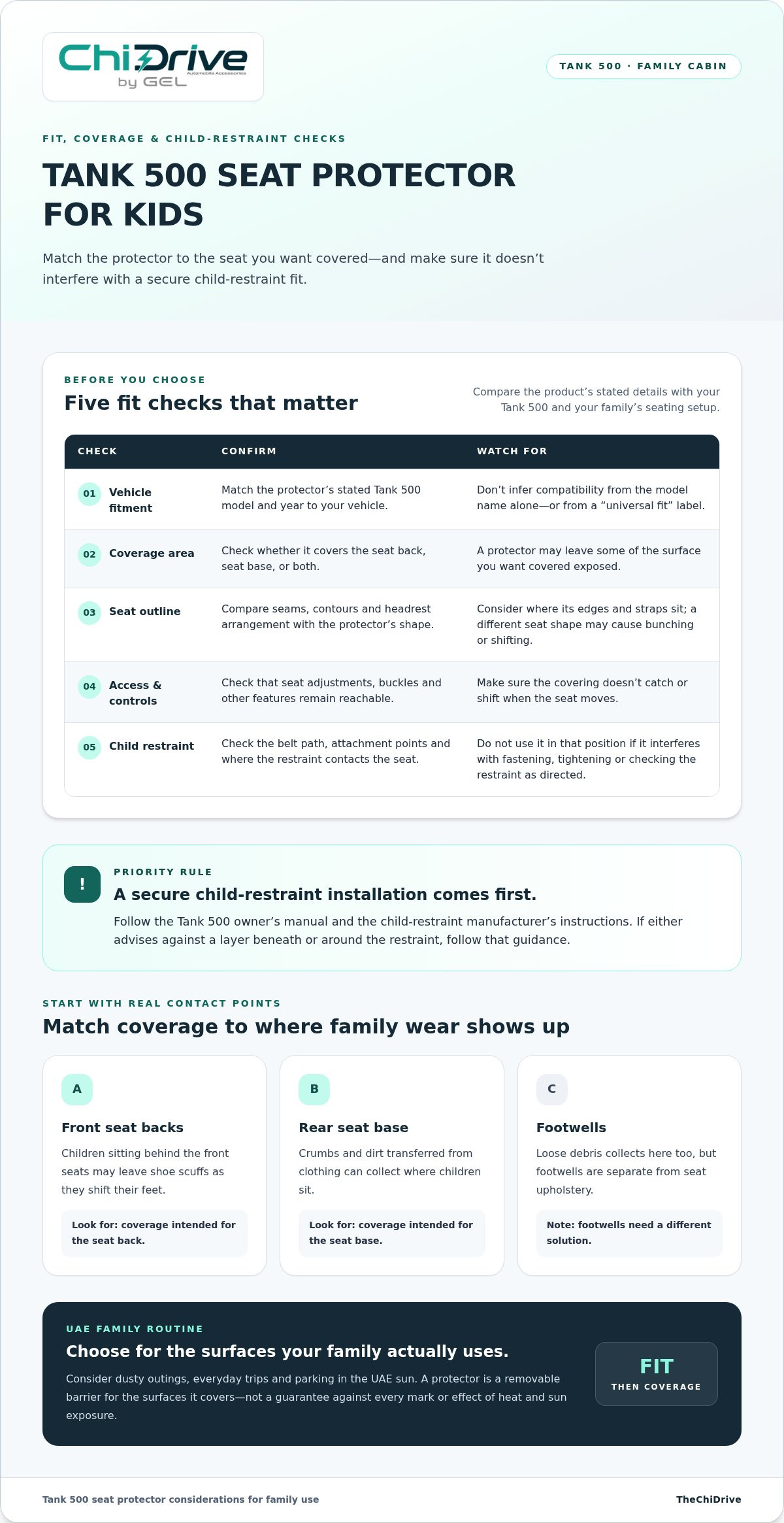
Begin with the places you can see getting marked during an ordinary journey. If children sit behind the front seats, the seat backs may pick up shoe scuffs as they shift their feet. The rear seat bases face different contact, such as crumbs or dirt transferred from clothing. Footwells collect loose debris too, but they are separate from seat upholstery and need a different solution.
Note which rear seating positions your family uses, then inspect the surfaces after a typical trip. If the front seat backs show scuffs, a seat-back layer may address the contact you notice. If crumbs collect on the rear seat base, look for coverage intended for that surface. General background on the vehicle is available on the GWM Tank 500 Wikipedia page.
What a seat protector can, and cannot, do
A protector can act as a barrier between routine scuffs or dirt and the surface it covers. Its practical value is that it may make a frequently touched area easier to maintain between deeper cabin cleans. It won’t necessarily cover every vulnerable spot, and no material should be assumed to prevent all marks, stains or effects from heat and sun exposure.
Keep upholstery care separate from child-restraint use. A protector must never take priority over a secure child-restraint installation. Follow the restraint manufacturer’s instructions when deciding whether a layer can be used beneath or around it. For model-relevant accessory browsing, ChiDrive’s Tank accessories collection brings together compatible aftermarket accessories for Tank vehicles. Check each product’s own description rather than assuming the collection includes a particular type of protector.
How to check Tank 500 fit and child-seat compatibility
A protector can look suitable in a product photo yet sit awkwardly on a particular seat or create a problem around a child restraint. Treat fit as a combination of vehicle, coverage and installation checks. For a Tank 500 seat protector for kids, match the protector’s stated model and year to your vehicle, then assess its shape and how your family uses that seat.
A “universal fit” label alone doesn’t tell you whether the edges will follow the Tank 500’s seat contours or leave controls accessible. Model-specific details are more useful, but don’t assume that a listing for one year or market configuration fits every Tank 500. Read the stated fitment and compare it with your vehicle and seating arrangement before choosing.
Check model year, seat shape and coverage area
Use this checklist before purchase. It helps separate a promising appearance from a practical fit:
- Match the vehicle details. Compare the protector’s stated model and year with your Tank 500. Don’t infer compatibility from the model name alone.
- Identify the surface. Confirm whether the design is intended for the seat back, seat base or both, and whether that matches the area you want covered.
- Compare the outline. Look at the seat’s seams, contours and headrest arrangement alongside the protector’s shape. Pay attention to where its edges and straps may sit.
- Locate controls and access points. Check whether seat adjustments, buckles and other features remain reachable after placement.
- Review the restraint setup. Compare where the protector will sit with the child restraint’s belt path, attachment points and contact areas.
These checks matter because a cover shaped for a different seat may bunch, shift or leave the intended area exposed. A precise-looking cutout isn’t proof of compatibility by itself. Consider the complete seating setup, especially if different rear seats are used for children, passengers or child restraints.
Keep child restraints and seat functions unobstructed
Child-restraint installation takes priority. A protector shouldn’t cover attachment points or belt paths, block buckles, or alter the way the restraint sits against the vehicle seat. Follow both the Tank 500 owner’s manual and the child-restraint manufacturer’s instructions. If either manual advises against a layer beneath or around the restraint, follow that guidance.
If a protector makes it harder to fasten, tighten or check the restraint as directed, don’t use it in that position. Keep seat adjustments accessible too, and make sure the covering doesn’t catch or shift when the seat moves. If the fit remains uncertain, follow the restraint manufacturer’s guidance rather than improvising.
Once you’ve completed these checks, use the Tank accessories collection to browse compatible aftermarket accessories for Tank vehicles. For a broader look at ChiDrive’s compatible aftermarket accessories, you can also explore ChiDrive online.
Compare Tank 500 seat protector materials and coverage for kids
Coverage and material are linked, but neither should be chosen in isolation. Start with the contact points you want to cover, then consider how the surface fits your cleaning routine and whether the protector leaves seat functions and child-restraint use unobstructed. The right Tank 500 seat protector for kids is the one that suits your family’s actual use, not simply the one covering the most upholstery.
Product listings may describe materials such as PU leather or fabric, but a material label alone doesn’t establish fit, cleaning results or suitability for your setup. Treat those descriptions as details to assess, not as a guarantee of performance. Use this comparison to focus your decision:
| Coverage type | Practical fit for family use | Trade-off to consider |
|---|---|---|
| Seat-back-only | Targets shoe contact on the back of a front seat when children travel behind it. | Doesn’t cover crumbs or marks on the seat base. |
| Seat-base | Focuses on the seating surface where food crumbs or dirt from clothing may collect. | Doesn’t address scuffs on the front seat back. |
| Broader coverage | May cover several selected surfaces for a family that regularly uses multiple seating areas. | More material can mean more edges and areas to keep clear of seat functions and restraint use. |
Choose coverage around children’s likely contact points
A front seat-back protector can make sense if children’s shoes regularly touch that surface. Consider wider coverage only if your family also needs protection on other seat areas. More coverage isn’t automatically more practical: check that it doesn’t block buckles, interfere with a child restraint or get caught against moving seat components as the seat is adjusted.
Think through a normal journey, from children climbing in to adults repositioning a seat. If the protector shifts, bunches or restricts access during those routines, the added coverage may not be worth the complication. Choose the area first, then assess whether the proposed shape works around it.
Assess material and cleaning needs realistically
Wipe-clean surfaces and fabric-style options present different care considerations. A smooth surface may make it easier to remove loose crumbs or some dirt with a cloth, while fabric may call for a different approach depending on its care instructions. Don’t assume either category is waterproof, heat-resistant or more durable without product-specific evidence.
In the UAE, dust can travel into the cabin after outdoor stops, and snacks on family journeys can leave crumbs or food marks. Consider how often you’re willing to clean the covered area and follow the care guidance for the material. Sun-exposed parking is another reason not to assume a protector will prevent heat effects. It covers a surface, but it does not promise temperature control.
For model-relevant browsing, the Tank accessories collection offers a starting point for exploring compatible aftermarket accessories. Compare each item’s stated fitment and coverage with the needs you’ve identified.
A practical Tank 500 seat protector checklist for UAE family use
A good choice should work on ordinary days, not just look right on a product page. Think about the Tank 500’s exact seating position, your child’s restraint setup and the family routine around the car. Sun-exposed parking, dusty shoes after an outing and quick trips between school, home and other destinations all shape what’s practical to install and maintain.
Use this checklist before ordering, then repeat the access checks once the protector is in place. Small details matter: a covered buckle or a layer that shifts can make an otherwise suitable setup inconvenient.
Before ordering: confirm the practical details
- Match the vehicle and seat. Compare the listing’s stated Tank 500 model year and intended seat position with your own vehicle. Don’t assume a universal-fit label means it suits every seat shape or configuration.
- Confirm the coverage. Check whether the protector covers the seat back, seat base or another specified area, and make sure that matches the wear points you want to address.
- Review what’s included. Read the listed contents so you understand whether the item covers one surface or more. Don’t infer extra pieces from a product photo.
- Understand how it attaches. Review the stated attachment method and consider whether it could interfere with seat movement, restraint attachment points or access to controls.
- Read care directions. Check the product’s cleaning instructions before choosing it for a routine that may involve dust, crumbs or marks from family journeys.
In the UAE, a car may spend time in direct sun between errands or at a mall, then pick up fine dust as children get in and out. Choose based on the care instructions and your likely cleaning habits, not an assumption that a particular material will withstand heat or prevent every mark. Colour can help a protector sit neatly with the cabin, but its appearance on a screen may differ from the product itself.
After fitting: check visibility, access and care
Install the protector according to its instructions, then check the entire seating area before carrying passengers. Seat belts, buckles, restraint attachments and adjustment controls should remain accessible. Follow the vehicle and child-restraint manuals, and don’t use the protector in a way that affects secure restraint installation.
After a short journey, inspect the edges and covered area. Look for movement, bunching or debris caught underneath, particularly after a dusty stop or when children have climbed in and out. If anything shifts or obstructs a function, refit it only as directed or discontinue use in that position. For cleaning, stick to the product’s care directions rather than trying an unlisted cleaner or method.
Once you’ve completed these checks, browse the Tank accessories collection for model-relevant options to consider for your family’s setup.
Find Tank 500-compatible accessories through ChiDrive
You’ve now got a practical basis for assessing seat coverage, fit and child-restraint clearance. The next step is to browse with those details in mind. TheChiDrive’s Tank accessories collection is a model-relevant destination for Tank owners exploring compatible aftermarket accessories.
Keep your Tank 500’s model year and intended seating position in view as you browse. TheChiDrive’s Guaranteed Fitment positioning matches accessories to the exact brand, model and year. Assess each item by its own stated fitment and description. A general Tank accessory listing shouldn’t be treated as proof that a particular item is a child seat protector or suits every seating arrangement.
Browse with model fitment in mind
For a Tank 500 seat protector for kids, look for clear product details that correspond to your vehicle and the seat area you want to cover. Consider whether the described coverage addresses your family’s main contact points, then keep the child-restraint manufacturer’s instructions central to your decision. A suitable accessory should fit into your routine without obscuring seat controls or compromising restraint use.
This model-first approach is useful beyond seat protection. A Tank collection brings relevant accessory browsing together, while each product’s details help you judge whether it belongs in your setup. Compare the stated model and year before adding an item to your plans. That simple step keeps the choice grounded in your actual vehicle rather than a similar-looking model or a broad category label.
Make the next step straightforward
TheChiDrive’s UAE shopping options are designed to make the order process clear. Cash on delivery is available across the UAE. Free UAE delivery applies to orders over AED 150, and delivery is within 10 days across the UAE. Orders have a 7-day return window. Review the relevant product information and applicable order details as you decide.
For families, the best next step is a considered one: revisit the fit checks, identify the surface you want to cover and browse the Tank accessories with your exact model and year in mind. If a listing describes an accessory that suits your needs, use its stated details to assess the fit for your setup. Keep restraint instructions and access to seat functions as non-negotiable checks.
Explore the Tank accessories collection to browse model-relevant options for your next family journey.
Make your next Tank 500 cabin choice with confidence
A family interior evolves. A child may move to a different seat, travel with new activities or start climbing in independently. Keep your priorities clear as routines change: the right coverage for your family, a tidy fit and no compromise to child-restraint use. Carry that standard forward when choosing a Tank 500 seat protector for kids.
Take a measured approach. Select an accessory for the need you can see today, then reassess the setup if your seating arrangement changes. Thoughtful choices can help keep the Tank 500 comfortable and ready for the journeys ahead.
Explore the Tank accessories collection to browse model-relevant options for your cabin.
Here’s to smoother family trips and an interior that feels considered, wherever the day takes you.
Frequently Asked Questions
Can a Tank 500 seat protector be used with a child car seat?
It depends on the protector’s shape and the restraint’s installation requirements. Before using a Tank 500 seat protector for kids, follow both the vehicle and child-restraint manufacturers’ instructions. Keep attachment points, belt paths and required contact surfaces clear, and check that the restraint can be installed exactly as directed. If the manuals conflict or the fit is unclear, follow the restraint maker’s guidance. Don’t improvise a setup.
Will a Tank 500 seat protector fit every model year?
Don’t assume a single fit claim covers every model year or seat configuration. Compare your vehicle’s exact year and intended seating position with the product’s stated fitment. A broad “Tank 500” label alone may not explain whether the seat shape or configuration matches. If a listing gives a year range, treat that as its stated scope rather than extending it to other versions.
Can a seat protector help keep children’s shoe marks off the Tank 500 seats?
It can create a barrier over the surfaces it covers, including a front seat back that children’s shoes may touch. The result depends on the protector’s coverage, fit and use, so it can’t guarantee that all marks or dirt will be avoided. First identify where contact actually happens. If a child restraint is used nearby, check that the protector doesn’t interfere with its installation or seat functions.
How do I clean a Tank 500 seat protector after a family trip?
Use the care directions provided for that specific protector, since cleaning needs vary by material and product. Don’t assume it can go in a washing machine, withstand water or be treated with a particular cleaner. If the care guidance allows, gently remove loose dust, then inspect seams and areas where crumbs may collect. Avoid harsh or unlisted cleaning methods, which could affect the surface.
Is a universal seat protector suitable for the Tank 500?
A universal label doesn’t establish a precise fit on a Tank 500 seat. Compare any stated dimensions and coverage with the intended seat, and consider how the protector sits around its contours. Before use, make sure belts, restraint attachments, buckles and seat adjustments remain accessible. Model-specific fitment can make the comparison clearer, but compatibility still depends on the product’s stated details.
What should I check before using a seat protector in the UAE?
Check fit, restraint compatibility, attachment and care directions before making it part of your routine. Dust from family outings and parking in sun-exposed areas may affect how often you want to inspect or clean the covered surface, but don’t assume a material resists heat or dust. After fitting, check for movement and confirm seat controls remain usable. Follow the vehicle and restraint manuals if their instructions differ.


